- Eino Vatileni
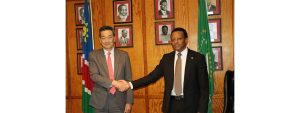
Japanese Ambassador to Namibia H.E Asazuma Shinichi, paid a courtesy visit to the Chairperson of the Parliamentary Standing Committee on Natural Resources Hon. Dr. Tobie Aupindi on Friday, at the National Assembly.
During the meeting, ambassador Asazuma emphasized the importance of Japan–Namibia cooperation, noting its critical role in Namibia’s development and Japan’s strategic resource security.
He highlighted that Japanese aid to Namibia began in the 1990s, particularly in education and infrastructure development. He further underscored Namibia’s significance as a provider of essential mineral resources and as a gateway to the SADC market.
The ambassador praised Namibia’s peaceful environment, which he said provides fertile ground for investment. He noted that Japanese companies such as Toyota Tsusho Corporation and MODEC are increasingly entering Namibia’s extractive industries.
Toyota Tsusho has partnered in a rare earth project, while MODEC is investing in the oil and gas sector. He also acknowledged the role of JICA in supporting Namibia, while recognizing the limitations posed by Namibia’s classification as a middle-income country.Speaking during the same meeting Hon. Dr. Aupindi expressed gratitude for the visit and outlined the mandate of the Parliamentary Standing Committee on Natural Resources, established under Article 59 of the Constitution and Rule 37 of the Parliamentary Rules.
The Committee oversees Namibia’s natural resources, including energy, oil and gas, mining, renewable energy, fisheries, wildlife, and environmental management.Dr. Aupindi stressed that energy and extractive industries are shaping the destiny of nations, citing global crude oil profits of half a trillion US dollars in 2025. He highlighted Namibia’s recent discoveries in the Orange Basin, which have placed the country firmly on the global energy map, offering extraordinary potential to transform the economy, create jobs, and uplift communities.
He cautioned, however, that natural resources bring responsibility as well as opportunity: “History is unforgiving on this point. Nations that manage their resources well rise. Those that do not fall into instability, inequality, and conflict. Namibia must choose its path deliberately and wisely.”
He reaffirmed Namibia’s openness to investment and respect for global operators, but insisted that the petroleum sector must be inclusive and transformative.
The chairperson emphasized the imperative of integrating Black-owned Namibian businesses into the petroleum value chain and not as a recommendation, but as a national necessity.
He noted that across Africa, resource industries have too often generated wealth that leaves the continent, while local populations remain excluded from ownership, skills development, and opportunity. “That model is not acceptable in Namibia,”.
“We expect clearly and unapologetically that Black-owned Namibian businesses must be actively integrated into supply and service chains,”Hon. Aupindi said.
He urged Japan to consider alternative models of support for Namibia, beyond the middle-income classification, given that wealth remains concentrated in the hands of a few.
He called on Japanese investors to embrace equality and accessibility, ensuring that new investments do not perpetuate exclusionary economic systems, but instead contribute to inclusive growth for all Namibians.