
- Eino Vatileni
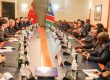
Members of the Parliamentary Standing Committee on Constitutional and Legal Affairs and Petitions met with officials from the Electoral Commission of Namibia in Gobabis on Friday to review the Draft Electoral Bill.
The consultative workshop focused on proposed amendments, identifying areas requiring further consideration, and developing recommendations for Parliament’s consideration.
The Electoral Bill seeks to modernize and strengthen Namibia’s electoral framework by addressing emerging challenges and enhancing the administration of elections.
Prior to its formal introduction in Parliament, it is necessary for members of parliament to familiarize themselves with the proposed provisions and engage with the Electoral Commission of Namibia on the rationale and implications of the proposed amendments.
Speaking during the official opening, committee chairperson hon. Pohamba Shifeta said any law that regulates the elections process must be handled with care, foresight, and a deep sense of responsibility.
He added that the role of the National Assembly cannot be underestimated.
“It is our constitutional duty to scrutinize every Bill, not as a formality, but as a safeguard for our democracy and social cohesion. First, to ensure legal soundness and constitutional compliance. The Bill must respect the fundamental rights and freedoms in Chapter 3, and the principles of equality, transparency and accountability,” hon.Shifeta said.
The chairperson added that lawmaking is not an exercise in isolation but it must speak to the ‘lived realities of the voter in Opuwo, the first-time voter in Katima Mulilo, the political party, the civil society observer, and the election official on the ground’.
“If the law does not carry public confidence, its legitimacy is weakened. This workshop is therefore not ceremonial. It is a space for candid engagement,” he added.
THE GENESIS
Speaking at the same event, Chairperson of the Electoral Commission of Namibia Elsie Nghikembua said the Commission commenced with a comprehensive electoral reform process in 2021 after the conclusion of the 2020 Regional Council and Local Authority (RCLA) Elections.
She said the process started with internal evaluation of performance of the 2019 Presidential and National Assembly and 2020 Regional Council and Local Authority elections.
Nghikembua added that it was then followed by written submissions by stakeholders on proposed amendments to the Electoral Act.
“During 2022 and 2023, the Commission held various engagements with stakeholders, including the former minister of urban and rural development.This was followed by stakeholder workshops to validate and consolidate inputs. The process culminated in the production of a Draft Electoral Amendment Bill, which was submitted to the former minister of urban and rural development for further processing,” Nghikembua said.
The two-day workshop concludes on Saturday.