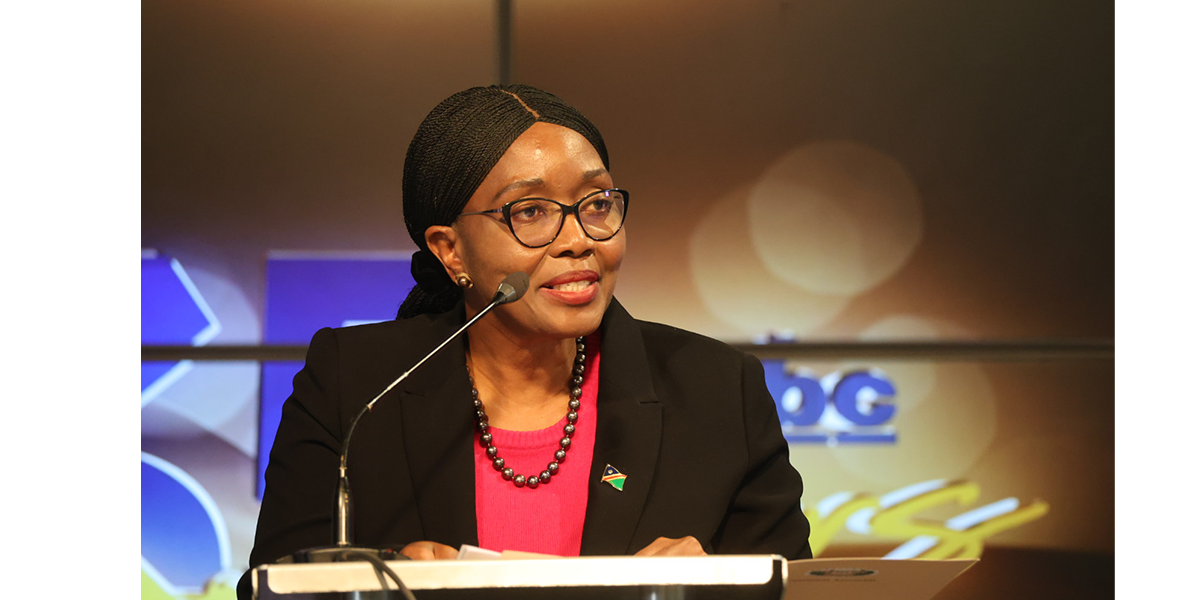
Speaker of the National Assembly Hon. Dr. Saara Kuugongelwa-Amadhila has called on media institutions to improve the way women, particularly those in leadership positions, are portrayed in the news.
Speaking at the 35th anniversary celebrations of the Namibian Broadcasting Corporation (NBC) in Windhoek on Friday, Kuugongelwa-Amadhila said media coverage often places disproportionate emphasis on controversy, personal conduct and criticism involving women while giving less attention to their professional achievements and contributions to society.
She warned that such reporting patterns have consequences beyond individual reputations.
“Media coverage frequently places undue emphasis on women’s issues framed in a negative light, on controversy or personal conduct, while giving comparatively little attention to women’s substantive contributions in government, business, science, and public life.
“The effect of this imbalance is not neutral. It erodes public confidence in women leaders, and it erodes the confidence of those women themselves. When the narrative surrounding a woman in a position of responsibility is constructed primarily from criticism and personalisation rather than from a substantive assessment of her work, it undermines the very democratic norms of accountability that the media must uphold,” she said.
According to her, persistent negative portrayals can erode public confidence in women leaders and discourage women from participating in public life.
“Media institutions do not simply report on the world; they help shape public perception of it,” she said.
Hon. Kuugongelwa-Amadhila said the media has a responsibility to ensure that women are assessed on the substance of their work rather than being reduced to personal controversies.
She stressed that her call was not for favourable treatment of women leaders, but for reporting that is fair, balanced and contextualised.
“I, therefore, call upon the NBC on this milestone anniversary to reflect critically on its editorial practices as they relate to gender. This is not a call for favourable coverage. It is a call for fair, substantive, and contextualised coverage, coverage that treats women leaders as the full professionals that they are,” she said.
The Speaker also raised concern about technology-facilitated violence against women, including online harassment, deepfakes, impersonation and coordinated disinformation campaigns.
She said such attacks are increasingly forcing women to limit their online presence and, in some cases, withdraw from public life altogether.
“A common consequence, well documented in the research, is that women withdraw from their online presence or reduce their public participation altogether. In the worst cases, they leave public life entirely,” she said.
Hon. Kuugongelwa-Amadhila urged public media institutions to take the issue seriously by refusing to amplify abusive content and by promoting responsible digital conduct.
She said the media has a powerful role in shaping social norms and creating a public environment where women can participate freely in political, professional and community leadership.
“Technology platforms continue to operate without sufficient accountability. Public media institutions can use their platforms, which have substantial reach, to take an active editorial position on this matter, to report on it seriously, to refuse to amplify abusive content, and to model the kind of responsible digital conduct that we wish to see adopted more broadly.
“The media has the power not only to reflect norms but to shape them. I recognise that we as legislators have the responsibility to legislate in a manner that reflects the needs of society and fully addresses them,” she said.
She called on media organisations to invest more in training journalists to improve the quality of reporting on complex national issues.
Kuugongelwa-Amadhila said journalists must be equipped with the technical knowledge needed to report accurately on specialised subjects.
She warned that inaccurate reporting on technical matters can distort public debate and weaken the media’s accountability role in a democratic society.
Added that the media should establish structured development programmes for journalists in areas such as economics, public finance, constitutional affairs, legislative processes, public health, environmental policy and technology.
According to her, journalists with a deeper understanding of these fields are better able to scrutinise public institutions and hold decision-makers accountable.
“A reporter who understands the legislative process will ask better questions of Members of Parliament. A reporter who understands fiscal policy will hold the Finance Ministry to a higher standard of account,” she said.
Kuugongelwa-Amadhila noted that the rapid growth of artificial intelligence and digital technologies has made specialist knowledge even more important for journalists.
She said the media must continue building its capacity to fulfil its democratic mandate through accurate, informed and responsible reporting.